Sunday, 30 November 2008

Karimun Jawa Island

Karimunjawa is and island chain stretching in a northwesterly direction 83 km from Jepara. Central Java. This archipelago is a cluster of 27 islands in the java sea. Only seven of the islands are inhabited. The reefs are a mixture of fringing, barrier, and patch with bottom depths ranging from 15 to 40 meters. The name of Karimunjawa is taken from Javanese language 'Kremun kremun saking tanah Jawi' addressed by one of Wali Songo (the Nine Saints who had introduced Islam in Java) to describe how far this mini archipelago from Java, to be exact from Semarang and Jepara. Stands from 27 islands, this mini archipelago became marine national park and it's like a treasure for those who love marine life. Here can be found protected coral reefs (very colorful plateaus and plains in deep and shallow waters), secluded and tranquil white beaches, pelican and hornbill, sea grass and kinds of sea creatures, from crabs, anchovy, starfish, sharks, stingray, jellyfish, red snappers, etc.


The Marine National Park Karimun Jawa is 110,000 ha and lies 90 km north east of Jepara in Central Java. We will find mangrove forest and beach forest. The park is named after the largest island Karimun Jawa. The vegetation consists mainly of mangrove and beach forest, although there is some lowland rain forest on Karimun Jawa. Most of the islands are surrounded by sandy beaches and fringing coral reefs. Fresh water is confined to a few small wells and forest streams on Karimun Jawa. A number of endemic animals live on the island while on the beaches sea turtles lay their eggs. The average tidal range is 92 cm.

The archipelagic Karimunjawa, thought not as known the Marine reserves near Ambon and Manado, has unexpectedly good beaches, reefs and lovely sea scopes. Corals seem to blossom in to gardens, with an Amazing variety of form and color fishers and marine plants. It lies 90 km away from Jepara and can reached by "KM. Adison I & KM Kota Ukir" boat, the only ferryboat connecting Karimunjawa and Jepara. The resort offers stunning dives and snorkeling trips for all sorts of divers from novice to experience. Fringing reefs, atolls, wrecks and an excellent variety of different species make diving in Karimunjawa an unforgettable adventure.

Tanah Lot Temple, Bali

Tanah Lot is located about 12 kilometers from Tabanan City and 20 kilometers from Denpasar. The area comprises a wondrous mixture of natural beauty and sheer human effort. Here lies an idyllic white sand beach with crashing waves, complemented by a small yet majestic temple. This temple, known as Pura Tanah Lot, juts out to sea on a rocky background. Tanah Lot attracts throngs of both locals and tourists daily. Most come here longing to catch a glimpse of the romantic Tanah Lot sunsets, a regular occurrence during the dry season (April to November).

The royal Taman Ayun temple was built by one of the last priests to come to Bali from Java in the 16th century. The temple stands on the top of a huge rock, surrounded by the sea and is one of Bali's most important sea temples. Tanah Lot pays homage to the guardian spirits of the sea. Ancient rituals pay homage to the guardian spirits of the sea. Poisonous sea snakes found in the caves at the base of the rocky island are believed to be guardians of the temple, standing Virgil against evil spirits and intruders. At the base of the rocky island are poisonous sea snakes believed to guard the temple from evil spirits and intruders. The best time to see Tanah Lot is in the late afternoon when the temple is in silhouette.

Friday, 28 November 2008

Borobudur Temple, Central Java

Borobudur is the biggest Buddhist temple in the ninth century measuring 123 x 123 meters. It is located at Magelang, 90-km southeast of Semarang, or 42-km northwest of Yogyakarta. Borobudur temple is the one of the best-preserved ancient monument in Indonesia that are most frequently visited by over a million domestic as well as foreign visitors. It also had been acclaimed by the world as a cultural heritage main kind. The architectural style has no equal through out the world. It was completed centuries before Angkor Wat in Kamboja. Borobudur is one of the world's most famous temples; it stands majestically on a hilltop overlooking lush green fields and distant hills. Borobudur is built of gray andesite stone. It rises to seven terraces, each smaller than the one below it. The top is the Great Stupa, standing 40 meters above the ground. The walls of the Borobudur are sculptured in bas-reliefs extending over a total length of six kilometers. It has been hailed as the largest and most complete ensemble of Buddhist relieves in the world, unsurpassed in artistic merit and each scene an individual masterpiece.


Borobudur temple built in the eighth century by the Cailendra dynasty, is believed to have been derived from the Sanskrit words "Vihara Buddha Uhr" the Buddhist Monastery on the hill. Borobudur is a terraced temple surmounted by stupas, or stone towers; the terraces resemble Indonesian burial foundations, indicating that Borobudur was regarded as the symbol of the final resting place of its founder, a Syailendra, who was united after his death with the Buddha. The Prambanan temple complex is also associated with a dead king. The inscription of 856 mentions a royal funeral ceremony and shows that the dead king had joined Shiva, just as the founder of the Borobudur monument had joined the Buddha. Divine attributes, however, had been ascribed to kings during their lifetimes. A Mahayana inscription of this period shows that a ruler was said to have the purifying powers of a bodhisattva, the status assumed by the ruler of Shrivijaya in the 7th century; a 9th-century Shaivite inscription from the Kedu Plain describes a ruler as being "a portion of Shiva."

The Borobudur was in danger of collapsing as its stone statues and stone cancer, moss and lichen affected bas-reliefs. But, the monument has been completely restored and was officially opened by the President on 23rd February 1983. The restoration took eight years to complete, funded by the Government of Indonesia with aid from the UNESCO and donations from private citizens as well as from foreign governments.

The visitors have the option of going by taxi or public bus to reach this temple. Public transportation is available from the bus terminal. From that point visitors can hire becaks or horse carts, or walk the rest of the way to the monument. A large parking area is available not far from the monument, so private cars and buses can park in this are

Tuesday, 25 November 2008

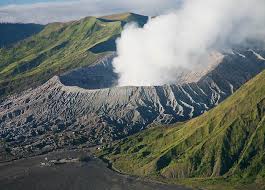
Mount Bromo, East Java

This National Park is one of the most beautiful places of interest in East Java. The beauties of mountain covered, give a special and characteristic green plants, arousing great interest.

Tenggerese traditional farming also makes this famous place being more interesting and attractive. In addition, cool and breezy wind always blows freshly giving ever visitor special deep impression a unforgettable memories.

The accessibility has no problem and very reachable (via Malang, Pasuruan, Probolinggo or Lumajang).
Surely, different access give different characteristics scenery landscape. The elevation reaches about 2.392 meter sea level above and the temperature varies from 3 up to 20 degrees centigrade.

Facilities: Star Hotels, home-stays, restaurants, and many others that visitors needed can be found.
The people who live in this area are supposed to be descended from Majapahit Kingdom about six hundred years ago. The belonged to Tenggerese Hinduism with old traditional. That tradition still survives up to now. Every year, they always carry out the traditional and religious ceremonies, and the most popular ones is Yadnya Kasada, an offering ceremony held at the edge of the crater on the top of mount Bromo.


The Story of Offering Kasada Ceremony

Hundreds years ago, during the reign of the last king of Majapahit, Brawijaya, the situation was so uncertain due to the expanding new religion, Islam. At the time, the queen gave birth a baby girl and named her Roro Anteng, later the princess married Joko Seger, a Brahma Caste.

Since the influences of the new religion was so strong that it created chaos. The king and his followers were forced to back off to the east, some of them reached Bali and some of them reached a volcano.

The new married couple, Roro Anteng and Joko Seger were also found among the fugitives who went to the volcano. Later they ruled the volcano area and named it Tengger. The word Tengger was derived from Roro Anteng and Joko Seger. Then he surnamed himself the riffle of Purba Wasesa Mangkurat Ing Tengger which means the righteous ruler of Tengger.

Years after year as the region flourished in prosperity, the King and Queen felt unhappy for they had no children to succeed their throne. On their desperation, they decided to climb the top of the volcano to pray and beseech before God, the Almighty. Deeply, impressed by the faith of their meditation affected the murmuring sound of the crater lifted up miraculously followed by a golden lightning that made the surrounding locked so scintillating. Their prayer were heard the God and would give them children, but they should sacrifice their last child as return. It was a promising future that could not be denied.

Not long after, the first baby boy was born and Roro Anteng named him Tumenggung Klewung. Child after child was born during the years and it reached 25 in number to whom she gave the named Kesuma for the last child.

Roro Anteng and Joko Seger were very happy ever since, love and affection were imparted among their children. Happiness lingered on years after years, but a dull and sad feeling still haunted them for their promise would be claimed one day. They realized that they could not run from the fact, a bitter disappointment of losing a child shot through their brains. The day came, the God reminded them of their promise which could not be avoided.

As they felt how cruel it was to sacrifice their beloved child, they decided to break their promise by not offering him to the God. They brought away their children in order to save their last child from the offering. They tried to find a place to hide, however, they could not find away.

All of by sudden, the dreadful eruption of the volcano followed to where they went and miraculously Kesuma, the last beloved child was swallowed into the crater. At the same time when Kesuma disappeared from their sight, turbulent brawl diminished and strange silence for a while but a sudden voice echoed: Hi, my beloved brothers and sisters. It was sacrificed to appear before God Hyang Widi Wasa to save all of you. And what I expect be in a peace and live prosperously. Don't forget to set mutual assistance among you and to worship God constantly to arrange an offering ceremony annually on 14th of Kasada (the twelfth month of Tenggerese calendar) by full moon. For the sake of your God. Hyang Widi Wasa.

Kesuma's Brothers and sisters held the offering ceremony annually just like what Kesuma advised and it was held from generation to generation up to now.

Bandealit Beach, Jember East Java

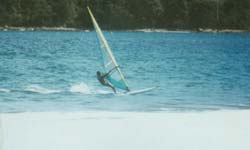
Bandealit is a beach resort situated in the forest area 35 km south of Jember. Nearby Bandealit, there is Sukamade Beach, Banyuwangi regency, which is the place of breeding sea turtles. This beach is famous for the calm waves and the beauty of the flora. Bandealit is very suitable for the visitors who like off-road activities because the road to Bandealit is difficult to travel. In Bandealit the visitors can hike, fish and windsurf. This beach often visited by the sea adventurous who like the challenges. The visitors can reach Bandealit by truck or rental car in 90 minutes from the central town.

Friday, 21 November 2008

Moyo Island, West Nusa Tenggara

Moyo Island, at the mouth of Saleh Bay, has a nature reserve with wild oxen, deer, wild boars and a great variety bird species. Visits are best made during the dry season from June through August. A few kilometers of the north coast of Sumbawa, the national park island of Moyo Island is probably the most rewarding destination in Sumbawa, surrounded by beautiful coral reefs and home to wild pig, monitor lizards, 21 species of bat, huge herds of native deer and hordes of crab-eating macaques. The best time to visit is in June and July, though the seas are clear and quiet from April. There are basic private rooms at the PHPA post at Tanjung Pasir on the south coast, where most boats from the mainland arrive. Renting a fishing boat from Tanjung Pasir and going fifteen minutes east to Stama reeft is very rewarding, with lots of sharks and turtles. There's nowhere on Moyo to rent masks and snorkels so bring our own; fins are advisable due to the strong currents.

To get to Moyo, take a bemo from beside Seketang Market in Sumbawa Besar to Air Bari , a small port settlement to the northeast. From Air Bari, we can charter a boat to Moyo.

National Parks of Indonesia: Moyo Island Reserve

Further along Nusa Tenggara to the east of Lombok lies Moyo Island and its Reserve. A fantastic place to visit and is a place of adventure.

Moyo Island is an attractive island three kilometres off the north coast of Sumbawa, lying to the east of Lombok. Two thirds of Pulau Moyo is actually a game reserve. The central plateau with its grassy savannah land and intermittent forested areas is ideal for Deer as well as the feral cattle released there.

The coastline has some beautiful beaches of fine coral sand and not the black volcanic sand like we find on a lot of islands in the archipelago. There are beautiful coral reefs, which make it excellent for scuba diving or just snorkeling. The reef at the southern end of the island is probably the best of all.

There are a few inhabitants on the island and this consists of around 21 villages concentrated in the northern end. From Moyo there are splendid views of Mount Tambora (2,821m) to the east, the highest mountain in Sumbawa, which erupted quite violently in 1815 but now has amazingly beautiful forests on its western slopes.

Tambora can be climbed from the side in three days and is well worth a visit. It has an enormous crater and within, a two-colored lake. From the crater there are also spectacular views over Saleh Bay and the rest of Sumbawa to the east, and to the west, Moyo Island to Lombok and Mount Rinjani.

The wildlife on the reserve has adapted to the fairly dry habitat and these include Deer, feral cattle, and numerous birds such as Orioles, Sunbirds, Coequals, Koels and Drongos. Of course there are several species of shore birds along the coastline.