Tuesday, 23 December 2008

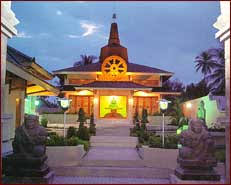
Nusa Dua, Bali Island

Bali's most prestigious resort area, Nusa Dua is where the tourists will find international world, class luxury hotels elegantly lining beautiful white sands. Located on the Bukit peninsula, in the southern part of Bali, approximately 10 km from the international airport. It is quiet and exclusive with superb facilities. Crystal clear water and stretches of white sandy beach of Nusa Dua makes Nusa Dua a perfect spot for luxurious resorts to which exhausted the bodies, after a Barong performance at Batubulan and a long climb of the steps of the Mother Temple Besakih, will want to rest. Some of the most sumptuous and luxurious hotels in the world find their home in Nusa Dua Bali. We can tee off into the sunset, while watching the gentle waves come from the blue sea and caress the banks surrounding the luscious greens. Tranquil swimming pools under the coconut trees seem to be one with the distant blue sea. Art galleries and numerous shops surround them.


Nusa Dua is really about taking it easy and relaxing in total luxury. As most of the hotels are 5 stars, every comfort is at our disposal as well as a gorgeous white sand beach. Nusa Dua was designed for the luxury conscious with a heavy concentration of big name hotels lining the beautiful white sand beach. The kind of activities on offer gives a flavor of Nusa Dua. The Bali Golf and Country Club, an immaculately landscaped 18 holes ocean view course. The Bali International Lawn Tennis & Lawn Bowls Club next to the Galleria Nusa Dua a spacious shopping mall with boutiques and up market restaurants. Close by Chandra Koka Amphitheatre provides a venue for traditional entertainment including arts festivals like the Nusa Dua Arts and Culture Festival. Stroll to the northern end of Nusa Dua for parasailing, jet skis, snorkeling/diving trips or better still, head for Tanjung Benoa.
Some of the resorts have private beaches but most areas are accessible. The stretch past the Hilton Resort has been a public beach and during the wet season, the outer reef there is a popular surf break. At present we will find some simple warungs selling good food at cheap prices along this beautiful stretch of white sandy beach that offers excellent swimming conditions in a protected lagoon.


Friday, 19 December 2008

Merapi Volcanoe

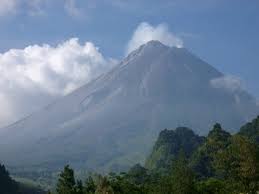
Merapi volcano is one of the world's most active and dangerous volcanoes. It contains an active lava dome, which regularly produces pyroclastic flows. It has been active for 10,000 years. This fire mountain remains one of the most active and dangerous volcanoes in the world. It can be seen from its name; Merapi from Javanese word 'Meru' means 'Mountain' and 'Api' means 'fire'. The internally giant smoking Mount Merapi is one of the active volcanoes that found in Indonesia. It is presenting its peaceful and sleepy dense forest.


Beyond this, there lies a vast deserted land with its deep and steep valley spread out among the mountain hills where sibilant pines and wild grass make out the dominating vegetation, all presents a very exciting panorama. Merapi is located about 30 km north of Yogyakarta, a city with a population of 500,000. It is tall (2.8 km or 1.7 miles high) and has steep slopes. The top of the volcano sometimes has a normal crater, but usually a broad mound of pasty lava (called a dome) fills the crater. The dome plugs up the volcano, making it difficult for other lava and ash to escape. A broad gouge funnels lava and ash flows from the top of Merapi to the south slopes of the volcano.

Monday, 15 December 2008

The Palace of Yogyakarta

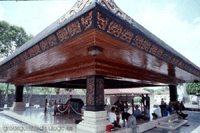
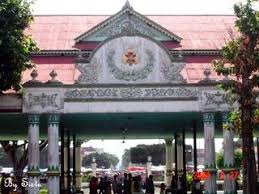
The palace court with its grand and elegant Javanese architecture lies in the center of the city. Prince Mangkubumi founded the palace in 1755. The Prince then was called Sri Sultan Hamengkubuwono I and he chose the right location of the compound between Winongo River and Code River. The palace stretches out from north to south. The front yard is called alun-alun Utara (the North Square), and the back yard is called Alun-alun Selatan (the South Square). The layout of the buildings shows that the Palace, the commemorative column and Mount Merapi lie in one line. The palace meeting hall is called Pagelaran, where formal meetings of palace officials are held, while the "Manguntur Tingkil" hall is the place where the Sultan is seated.

The visitors can enjoy the atmosphere of the kraton in former times by visiting the life-size diorama of wedding ceremonies on the palace meeting hall, performed by puppets, which are intentionally arranged to create such an atmosphere. Sets of Javanese musical instruments, antiques and heirlooms have made the palace of Yogyakarta worth to visit. Many sets of gamelan music instruments, antiques, and heirlooms make the palace of Yogyakarta the most interesting tourist attractions in Yogyakarta. The palace of Ngayogyokarto Hadiningrat is now the dwelling place of Sultan Hamengku Buwono X and the family.

Friday, 12 December 2008

Kuta Beach, Bali Island

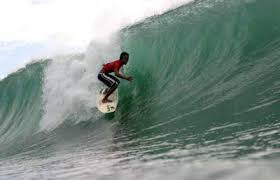
Once a lonely little village on the road from Denpasar to Bukit Peninsula, Kuta is now the tourist Mecca of Bali, popular mainly among the young and adventurous. Kuta beach is one of the first favorite beaches discovered by tourist. Coconut trees line the sand beach as far as the eyes can see towards the north stopped by the runway of Denpasar's airport far in the west. The sunset in Kuta is most breathtaking. On the south, the beach is fenced by the airport's runway, which gives the visitors a breathtaking landing experience. Kuta Beach bustles with tourists' vendors and locals. It's the most popular beach in Bali and the island's number one party zone. The beach stretches as far north as the eyes can see. As short walk away north, the waves will invite to surfing. Rapid development and an influx of visitors haven't kept the surfers away and Kuta still remains one of Bali's best surfing beaches and a great place to enjoy a beach lifestyle.


While the surfers are still part of the Kuta scene, it's the shopping, nightlife and party vibes that attracts thousands of visitors. There's a huge choice of accommodation, restaurants and entertainment. The accommodation in Kuta range from a modest home stay for a few dollars a night to luxurious, five star, international hotels costing several hundred to several thousand dollars a night. Legian Street, situated directly behind the row of hotels that face the beach, is lined with shops of all varieties. We can find any Balinese handicrafts here, from the least expensive to the most exquisite; or unique stores such as the leather store staffed by two young Balinese men that will perfectly sculpt a leather jacket. (They are all extremely talented artists). _At night, Kuta is alive with night life. Western influences create discotheques, dance clubs, and pubs. Gastronomical demands inspire a multitude of restaurants, serving traditional Indonesian and Balinese food to various ethnic meals from Japan, Switzerland, etc. As if these were not enough, various Balinese dance performances are staged in Kuta every night. One of the best Kecak performances is found in Kuta.

Ngebel Lake, Ponorogo East Java

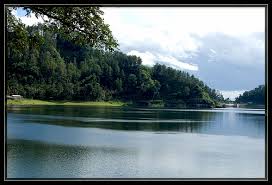
It is called Ngebel Lake because it is in Ngebel subdistrict territory. It is located about 24 km to the north-east of Ponogoro, Ngebel lake is in the slope of Wilis mountain with 734 metre height on the sea and the temperature 22 to 32 celsius.
With the wide of surface about 1.5 km, Ngebel lake surrounded by the road along 5 km. This lake has an amazing panorama, cool air with the maiden nature condition that kept one million potentials to be dug up. We also could met various fruits like: durian, mangosteens, pundung, etc. In the lake also spread various fishes, one them is the variety fishes that has protected. It is Hampala fish or the local inhabitants named Ngongok fish. For that purposes, it also available accommodation facilities that already for the visitor who want to spend the night. The facilities is managed by the Regional Government and private enterprise.
According to the developing legend in the community, Ngebel lake was formed based on the story of a dragon snake, named “Baru Klinting”.


When the snake take a meditating and unintentionally he was cut-piece by the community around to be eaten. Mysteriously the snake changed into a child who afterwards visited the community and made a contest to repeal the rib that was transfixed by him into the land. Not even one succeeded in carrying it out.

Afterwards he repealed this rib, and from this rib hole went out water that afterwards became the big pool that welled up and became Ngebel lake. It seems Ngebel lake had important role in the history of Ponorogo Regency, because one of the founders of Ponorogo regency, Batoro Katong, before doing the greatness Islam religion in Ponogoro regency had clear himself in a pool near to Ngebel lake. At this time, it is known as pool / Kucur Batoro.

Monday, 8 December 2008

Banda Island, Maluku

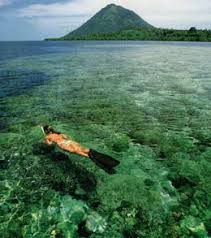
The Banda group, about 160 kilometers southeast of Ambon, consists of three larger islands and seven smaller ones, perched on the rim of Indonesia's deepest sea, the Banda Sea. Near Manuk Island, the water reaches more than 6,500 meters depth. Of the three biggest islands Banda, Banda-Neira and Mount Api, the first two are covered with nutmeg trees and other vegetation. The third however, is entirely bare and highly volcanic. The last eruption of Mt. Api occurred only a few years ago. The seas around Banda are the sites of the famous Maluku sea gardens with their bright corals and colorful fish darting through the crystal-clear waters. Facilities for sightseeing, snorkeling and skin-diving are available, as well as clean, comfortable cottages.


Banda saw some of the bloodiest episodes of Maluku's past history during the 17th century. In 1609, the Dutch East Indies Company (VOC) dispatched Verhoeff to the islands to obtain the contested spice trade monopoly at any cost. Confronted by a superior power, people Banda were forced to allow the company to establish a fort, but in that same year Verhoeff was killed together with 45 of his men. The Company retaliated, but peace was not restored. In 1619, V.O.C. Governor-General Jan Pieterszoon Coen arrived at the head of a penal expedition and exterminated the entire population of Banda. The land was divided into lots, called "perken”, and given to former company employees, the "perkiniers", who were obliged to grow nutmeg and sell them at predetermined prices to the company. Slaves did the actual work in the fields. The old "perkenier houses", or what is left of them, and old churches still retain a peculiar colonial character to the port town of Bandaneira today. Two old forts Belgica and Nassau are inside the town limits. Others are found elsewhere on the islands. See also the former Dutch Governor's mansion, the History Museum in Neira, and the huge nutmeg plantation nearby.

Sunday, 7 December 2008

Lovina Beach, Bali Island

Near the northern tip of the island of Bali lies a stretch of villages by the Bali Sea. Lovina Beach is the name. Lovina is really a string of coastal villages to the west of Singaraja. Escape from the hustle and bustle of Kuta to Lovina Beach located in north Bali, about 100 kilometers from southern tourist hotspots. It is well known as an excellent site for sunset watching, snorkeling, and diving. Darkly beautiful, Lovina offers quiet and calm, and is popular Asian tourists and those avoiding the hustle and bustle of the southern beaches. A number of coves offer tranquil, protected waters and Lovina is one of them. Although the sand is grey, it is quiet and peaceful, and popular among those who shun the glitzier beach resorts of the south. It is a popular place for dolphin watching; dolphins play in the water off Lovina. Famous for its early morning dolphin-watching boat trips, Lovina also offers good snorkeling and diving, and trekking in the nearby mountains. Diving off Menjangan Island, part of the Bali Barat National Park, is generally regarded as the best in Bali. Boats are readily available to take divers over to the island, where there are no residents or hotels.

Nightlife activities are also abound, as well as chartered boats to go out into the sea. If we like what Kuta offers but do not like the crowd. With a wonderful variety of hotels, restaurants and bars located on or very near the calm beach, Lovina offers something for everyone. It is also a good base to take day trips to the nearby attractions of north and west Bali.

Saturday, 6 December 2008

SOEKARNO GRAVEYARD

One of the tourist attractions in Blitar municipality is the tomb of Soekarno, an Indonesian proclamation reader and the first President of the Republic of Indonesia. It is located at 60 Slamet Riyadi Street, Bendogerit village, Sunan wetan district, about 2 kilometers from Blitar city.

The architectural "Joglo" dominates the tomb. It is in East Javanese style and combined with Gateway of Bentar. Beside the main building formed cover grave house of ‘Bung Karno’, this graveyard complx also completed with support building that is; Gapura Agung (The Great Gate), Mosque, and hall; which make the visitor feel comfortable to pilgrim in this location. There is also the complement building, consist of the grave manager house, public relax place, park area, and park. The impression is as great as the first president himself when he was still alive.

The tomb is visited by many pilgrims and opened for public. A lot of people come to visit at the time of memorial ‘Khol’ (the day of the death) of the Indonesia’s proclaim. The average of the visitors’ is amount to 150,000 per year, including both domestic and foreign visitors.

The great name of Soekarno invites the tourists to have pilgrimage tour to this graveyard. They feel astonished with the great president Soekarno, so that they pray in this graveyard to ask the benediction.

Tuesday, 2 December 2008

Imogiri, Yogjakarta

Imogiri is the official cemetery of the royal descendents from Yogyakarta and Surakarta. This cemetery located on a beautiful hill about 12 km from Yogyakarta. The royal graveyard is reachable by 345 stone steps leading to it. Imogiri is about 17 km Southeast of Yogyakarta and easily accessible by the bus of car. The tombs are built within three main courtyards. This Graveyard is the tomb of Sultan Agung Hanyokrokusumo, the third king of the Islamic Mataram Kingdom. All the kings of the Mataram Kingdom, from Sultan Hamengku Buwono I until Hamengku Buwono IX and their families as the Surakarta Kingdoms as well were all buried at the Imogiri Royal Cemetery.


This cemetery was built in 1645. Everyday many people visit Imogiri and step up on 345 stairs to reach the top of the hill where the tomb of the kings rested. Entry into the smaller courtyards housing the tombs of the princes is allowed, but the tomb can only be visited only on Monday 09.00 - 12.00 and Friday 13.00 - 16.00. The visitors must wear the traditional Javanese dress, which however can be hired on the spot at a modest fee. The cemetery is closed during the Moslem month of Ramadhan.